How to Break Unhealthy Habits and Build Better Ones
Why Are Unhealthy Habits So Difficult to Break?
Most people have at least one habit they would like to change.
You might want to spend less time scrolling, stop procrastinating, reduce unnecessary snacking, become more consistent with exercise, or create a healthier evening routine.
You know what you want to do differently, but somehow you find yourself repeating the same behavior.
This can happen because habits are often connected to familiar situations, emotions, and routines. When a behavior is repeated in a consistent environment, it can gradually become more automatic.
For example, you might automatically reach for your phone whenever you sit on the couch. You may snack whenever you watch television, even when you are not particularly hungry. You might postpone an important task whenever it feels overwhelming.
These behaviors can become familiar responses to everyday situations.
The challenge is that simply deciding to stop does not always change the cues and circumstances that encourage the behavior.
A more practical approach is to understand what triggers the habit, make the unwanted behavior less convenient, and create an alternative that is easier to repeat.
Habits Are Built Through Repetition
A habit does not usually appear overnight.
It develops as a behavior is repeated in familiar circumstances. Eventually, the situation itself can begin to trigger the response.
For example:
- You wake up and automatically check your phone.
- You finish dinner and immediately look for something sweet.
- You sit down to work and open social media before starting.
- You feel stressed and turn to scrolling for distraction.
Recognizing these patterns is the first step toward changing them.
Willpower Is Not the Only Factor
It is easy to assume that breaking a bad habit requires stronger discipline.
However, your environment, daily schedule, access to certain behaviors, and emotional state can all influence what you do.
If your phone is always beside you, checking it is convenient. If unhealthy snacks are constantly within reach, eating them may require little thought. If exercise equipment is difficult to access, starting a workout may feel like another obstacle.
Changing the environment can make a healthier choice easier without requiring you to rely on motivation every time.
Understand the Habit Loop
One useful way to understand everyday habits is to examine the pattern connecting a trigger, a behavior, and its immediate result.
A habit loop can be described in three basic parts:
- Cue: Something that triggers the behavior.
- Routine: The action you perform in response.
- Reward: The result or feeling that encourages the behavior to happen again.
Consider an example involving phone use.
- Cue: You feel bored while waiting.
- Routine: You unlock your phone and open social media.
- Reward: You receive entertainment or temporary distraction.
The behavior may become more automatic because the same situation repeatedly leads to the same response.
Recognize the Cue
A cue can be a time of day, a location, an emotion, another activity, or something in your environment.
Examples include:
- Seeing your phone on your desk
- Feeling overwhelmed by a task
- Sitting down after dinner
- Walking into the kitchen
- Receiving a notification
- Having a few minutes of free time
When you identify the cue, you can begin planning a different response.
Understand What the Behavior Provides
Unwanted habits often serve a purpose in the moment.
Scrolling may provide entertainment. Procrastination may temporarily reduce discomfort. Snacking may offer enjoyment or become part of a familiar routine.
Understanding what you get from the behavior can help you choose a replacement that meets a similar need in a healthier or more useful way.
For example, if you scroll because you need a break, you might try a short walk, music, stretching, or a few minutes away from your workspace.
Change the Response
Once you understand the cue and the reward, choose a different action.
You do not need to eliminate every trigger from your life. Instead, you can practice responding to familiar situations differently.
If you usually check your phone when you sit down to work, place it somewhere less accessible and begin with a small task.
If you snack automatically while watching television, consider preparing a different activity for your hands or choosing a snack intentionally rather than eating out of habit.
The goal is to interrupt the old pattern and give a new response an opportunity to develop.
Identify the Triggers Behind Your Habits
Before attempting to change an unwanted behavior, spend a few days observing when it happens.
You may discover that the habit is connected to a particular time, activity, emotion, or environment.
Keep a Simple Habit Journal
Whenever you notice the behavior, write down a few details:
- What were you doing immediately beforehand?
- Where were you?
- What were you feeling?
- What triggered the action?
- What did you get from doing it?
- How did you feel afterward?
You do not need to record every detail. A few brief notes can reveal useful patterns.
For example, you might discover that you spend more time scrolling when you feel tired after work or that you procrastinate most often when a task seems too complicated.
That information gives you something specific to address.
Look for Repeated Situations
After several days, review your notes.
Do you notice that the behavior happens at the same time or in the same location?
Does it occur when you feel bored, stressed, lonely, or overwhelmed?
Does a particular object or notification trigger the action?
Understanding these patterns helps you move beyond vague goals and develop practical solutions.
Separate the Trigger From the Response
You may not be able to avoid every situation that triggers an unwanted habit.
You will still experience boredom, stress, tiredness, and moments when you have nothing to do.
However, you can practice changing what happens next.
For example:
Old response: Feel bored, unlock phone, scroll for 20 minutes.
New response: Feel bored, take a short walk, read a few pages, or enjoy a quiet break.
The trigger may remain, but your response can change.
Decide Which Habit You Want to Change First
One common mistake is trying to change too many habits at the same time.
You might decide to exercise daily, eat differently, stop scrolling, wake up earlier, improve your sleep routine, and become more organized all in one week.
Although the motivation may be genuine, managing too many changes can make your routine difficult to maintain.
Start with one priority.
Choose a Habit That Affects Your Daily Life
Think about the behavior that creates the most frustration or interferes with something important.
For example:
- Excessive phone checking may interrupt your work and relationships.
- Procrastination may make everyday responsibilities more stressful.
- Inconsistent exercise may prevent you from maintaining an active routine.
- Late-night scrolling may interfere with your intended bedtime.
- Impulsive shopping may make it harder to follow your spending plan.
Choose one behavior that you genuinely want to change.
Make Your Goal Specific
Instead of saying, "I want to be healthier," define an action you can repeat.
Examples:
- I will walk for 10 minutes after lunch.
- I will keep my phone away during dinner.
- I will prepare tomorrow's priorities before going to bed.
- I will read for 10 minutes instead of scrolling before sleep.
- I will begin my most important task before opening recreational apps.
A specific action makes progress easier to recognize.
Connect the Change to a Personal Reason
Your reason for changing a habit can help you stay committed when motivation fluctuates.
You might want more energy, better focus, stronger relationships, more time for hobbies, or a calmer daily routine.
Write down why the change matters.
A meaningful reason gives your goal direction beyond simply trying to stop doing something.
Make Unhealthy Habits Harder to Repeat
One of the most practical ways to change a habit is to introduce friction.
Friction means making an unwanted behavior slightly more difficult or inconvenient.
You do not have to rely entirely on self-control if you can adjust your environment to reduce automatic access.
Move Temptations Out of Immediate Reach
Small environmental changes can interrupt familiar routines.
For example:
- Keep your phone away from your workspace.
- Avoid leaving distracting devices beside your bed.
- Put unnecessary shopping apps out of sight.
- Keep recreational snacks away from your desk.
- Store gaming controllers outside your usual work area.
These adjustments do not make a behavior impossible, but they create an opportunity to pause before repeating it.
Reduce Digital Distractions
If you want to spend less time on your phone, consider changing how your device is arranged.
You can:
- Turn off unnecessary notifications.
- Remove distracting apps from your home screen.
- Set specific times for checking social media.
- Use focus settings during work or study.
- Keep your phone in another room during selected activities.
These steps can make automatic checking less convenient.
Create a Physical Boundary
Sometimes, moving a tempting item into another room is not enough.
You may simply retrieve it whenever the urge appears.
A more structured boundary can help when you want to commit to a specific period without access.
For example, if you want to avoid checking your phone during focused work, you can place it in a timed lock box before starting.
The important idea is to make the decision before the temptation occurs, rather than negotiating with yourself repeatedly.
Replace Old Habits With Healthier Alternatives
Stopping an unwanted habit can leave a gap in your routine.
If you normally scroll whenever you feel bored, what will you do instead? If you usually snack while watching television, what activity will replace that familiar behavior?
Choosing an alternative makes change more practical.
Replace Phone Scrolling With an Enjoyable Activity
If you want to reduce unnecessary screen time, consider alternatives such as:
- Reading a book
- Going for a walk
- Listening to music
- Journaling
- Cooking
- Working on a creative project
- Stretching
- Spending time with family or friends
Choose activities that match the reason you usually reach for your phone.
If you want entertainment, find something enjoyable. If you need rest, choose something relaxing.
Replace Procrastination With a Smaller First Step
Large tasks can feel overwhelming, making it easier to postpone them.
Instead of trying to complete everything at once, identify the smallest useful action.
For example:
- Open the document and write one paragraph.
- Organize one section of your workspace.
- Prepare the materials for tomorrow.
- Work for five minutes before taking a break.
- Complete one small part of a larger project.
Starting can be easier when the first step feels manageable.
Replace Unhelpful Evening Habits With a Wind-Down Routine
If you tend to spend late evenings scrolling, create a different sequence of activities.
- Finish essential tasks for the day.
- Prepare your clothes or belongings for tomorrow.
- Put your phone away for a planned period.
- Read, stretch, or listen to calming audio.
- Follow a consistent bedtime routine.
The goal is to give your evening a familiar structure that does not depend on your old habit.
Make the Alternative Satisfying
A new behavior is easier to repeat when you enjoy some part of the experience.
You could listen to music while cleaning, walk with a friend, choose books that interest you, or celebrate completing a small goal.
Positive experiences can help make the replacement routine more appealing.
Make Better Habits Easier to Start
Breaking an unwanted habit is only part of the process. You also need to make the behavior you want easier to repeat.
A new habit should fit naturally into your everyday routine.
Start Smaller Than You Think You Need To
If you want to exercise regularly, begin with a short walk.
If you want to read more, start with a few pages.
If you want to meditate, begin with a few minutes of quiet breathing.
Small actions may seem insignificant, but they make it easier to begin and repeat the behavior.
You can gradually increase the activity as it becomes more familiar.
Attach the New Habit to an Existing Routine
A useful strategy is to connect a new behavior to something you already do regularly.
For example:
- After breakfast, take a short walk.
- After brushing your teeth, prepare your daily priorities.
- After finishing work, spend 10 minutes tidying your workspace.
- After dinner, read a few pages of a book.
- Before getting into bed, put your phone in its designated place.
An established routine can serve as a reminder to begin the new action.
Prepare Your Environment in Advance
Make it easier to follow through by preparing what you need beforehand.
For example:
- Put walking shoes near the door.
- Keep a book beside your favorite chair.
- Prepare your workout clothes the night before.
- Keep a water bottle on your desk.
- Place your journal somewhere visible.
- Organize the materials needed for your next task.
Reducing preparation effort can make a new behavior easier to start.
Use If-Then Planning
An implementation intention is a simple plan that connects a situation with a specific response.
You can create one using this format:
If [situation happens], then I will [specific action].
Examples:
- If I feel the urge to scroll during work, then I will put my phone away and work for five minutes.
- If I feel bored after dinner, then I will read or take a short walk.
- If I want to procrastinate, then I will complete one small part of the task.
- If I reach for an unnecessary snack, then I will pause and decide whether I actually want it.
Having a plan ready can make it easier to respond differently when familiar triggers appear.
Use Small Goals to Build Consistency
Consistency is an important part of developing new routines.
However, consistency does not mean performing perfectly every day. It means creating a realistic pattern that you can return to, even when life becomes busy.
Focus on Repetition Rather Than Perfection
You do not need to complete a new habit perfectly for it to be worthwhile.
If you planned a 30-minute walk but only have time for 10 minutes, you can still complete a shorter version.
If you cannot follow your usual evening routine, choose one small action that helps maintain the pattern.
A flexible routine is often easier to sustain than one that requires ideal conditions.
Track Your Progress
Use a notebook, calendar, or habit-tracking tool to record your actions.
You might mark each day you complete your chosen behavior.
Tracking can help you see patterns, recognize progress, and identify situations that make the habit difficult.
Keep the tracking process simple. It should support the habit rather than become another demanding task.
Celebrate Small Improvements
Acknowledge progress as you go.
You might recognize that you checked your phone less often, completed a task you had been avoiding, or followed your new routine several days in a row.
The reward does not need to be expensive or elaborate. Simply noticing your progress can make the process feel more encouraging.
Give Habits Time to Develop
There is no universal number of days required to form a habit.
The time can vary depending on the behavior, the person, and how consistently the action is repeated.
Instead of expecting a new routine to become automatic within a fixed period, focus on practicing it regularly in a familiar context.
Create an Environment That Supports Positive Change
Your surroundings can make a significant difference in whether you repeat an unwanted behavior or follow through on a healthier alternative.
Rather than relying only on motivation, arrange your environment to support the changes you want.
Organize Your Physical Space
Look around your home or workspace.
Are there objects that encourage habits you want to reduce? Are the tools you need for positive habits difficult to find?
Consider making small adjustments:
- Keep distracting devices away from your main workspace.
- Place books and creative materials somewhere accessible.
- Prepare exercise equipment in advance.
- Keep your kitchen organized around the foods you want to prepare.
- Create a designated area for focused activities.
A supportive environment can reduce unnecessary decisions throughout the day.
Spend Time Around Supportive People
The people around you can influence your routines.
If you want to become more active, consider walking with a friend. If you want to reduce phone use, suggest phone-free meals with family members. If you want to develop a reading habit, join a book group.
Shared goals can provide encouragement and accountability.
Make Your Desired Behavior Visible
Use reminders that make the new habit easy to remember.
A note on your desk, a calendar reminder, or an object placed in a visible location can serve as a cue.
For example, placing your journal beside your bed may remind you to write before sleeping.
The more naturally the reminder fits into your environment, the easier it may be to follow through.
What to Do When You Slip Back Into an Old Habit
Changing habits is rarely a perfectly straight process.
You may follow your new routine for several days, then return to an old behavior when you are tired, stressed, distracted, or dealing with an unexpected situation.
That does not mean your progress has disappeared. A temporary lapse is an opportunity to learn more about what makes the habit difficult to change.
Avoid the All-or-Nothing Mindset
One missed workout does not mean you have abandoned exercise.
One evening of excessive scrolling does not erase the progress you have made toward healthier phone habits.
Avoid turning a single setback into a reason to stop trying.
Return to your next planned action instead.
Identify What Made the Habit Difficult
Ask yourself:
- Was I tired or overwhelmed?
- Did I encounter an unexpected trigger?
- Was my new routine too complicated?
- Did I make the unwanted behavior too easy to access?
- Did I have a realistic alternative available?
Understanding the situation can help you make a better plan.
Adjust Your Routine Instead of Giving Up
If your original goal is difficult to maintain, make it smaller or change the timing.
For example, if you cannot exercise for 30 minutes every morning, begin with 10 minutes after lunch.
If you struggle to keep your phone away all evening, start with a phone-free period during dinner.
A routine that fits your real life is more useful than one that looks perfect on paper but is difficult to follow.
Know When Additional Support May Help
Some behaviors involve more than ordinary habit patterns. Substance dependence, compulsive behaviors, disordered eating, and other serious concerns may require professional support.
A habit tool or personal routine should not replace appropriate medical or mental health care.
If a behavior is causing significant distress, affecting your health, or feels difficult to control despite repeated efforts, consider speaking with a qualified professional.
Use Timed Lock Box Plus to Create Better Boundaries
Knowing that you want to change a habit is important, but following through can be difficult when the temptation is always within reach.
You may decide to stop checking your phone during work, only to pick it up again a few minutes later. You might plan to avoid late-night scrolling but find yourself unlocking your device whenever you wake up.
In these situations, changing your environment can help.
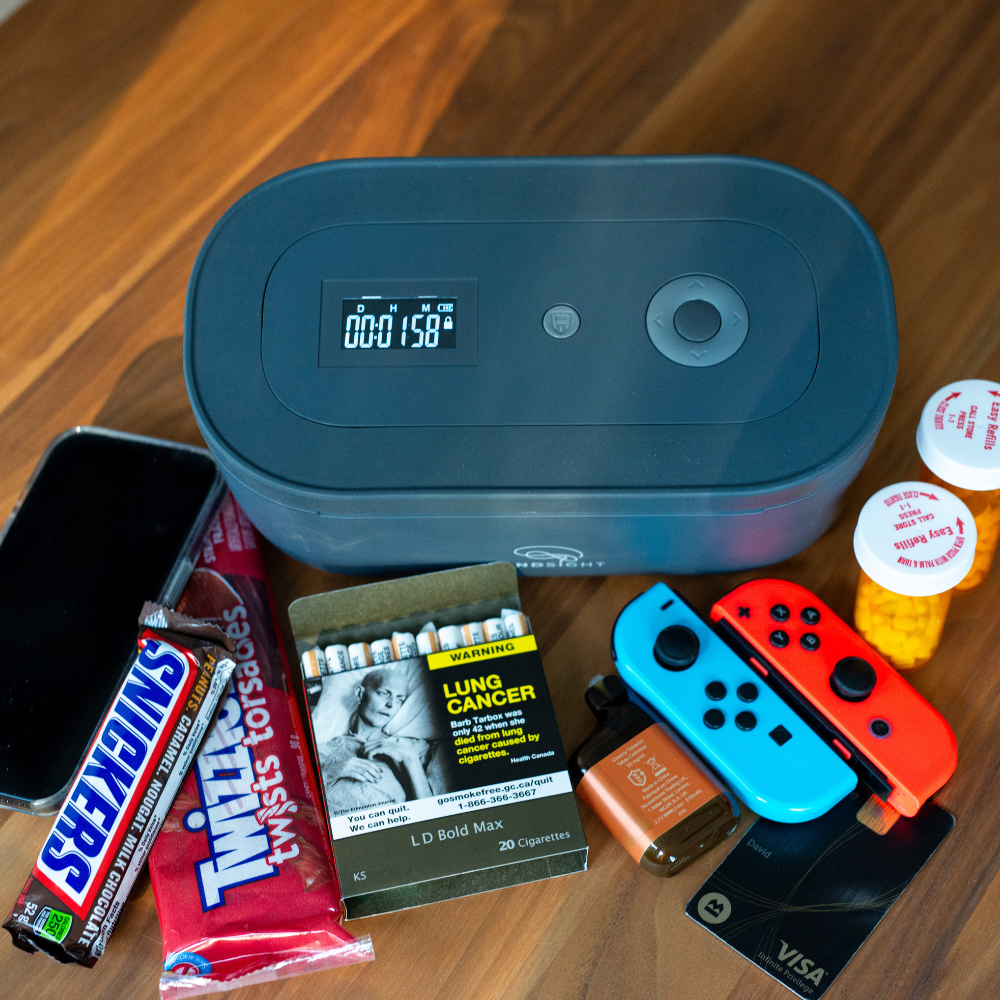
Mindsight Timed Lock Box Plus
Mindsight Timed Lock Box Plus is designed to create a physical boundary between you and items that may trigger unwanted habits.
Rather than relying entirely on repeated decisions, you place selected items inside the box, choose a timer, and allow the lock to help maintain the boundary.
How Timed Lock Box Plus Works
The Mindsight Timed Lock Box is available in a Plus size option and offers three locking modes:
- Lockbox Only: Provides storage without setting a timed lock.
- Standard Mode: Uses a timed countdown with an override-code option.
- Fortress Mode: Provides a more committed timed lock without an easy in-box override.
The timer can be set from one minute to 30 days. Once the locking process is completed, the countdown runs until the selected time ends.
The box is designed to hold multiple phones or other small items, depending on their size and configuration. It also includes a charging pass-through so compatible devices can charge while secured inside.
Ways to Use Timed Lock Box Plus to Support Better Habits
Reduce phone distractions during work: Put your phone inside before starting a focused work session. This can help reduce the temptation to check notifications or open recreational apps.
Create a more intentional evening routine: Set aside a period without access to your phone so you can focus on reading, preparing for the next day, or spending time with family.
Reduce access to gaming devices: Store controllers or other compatible small items during periods when you want to focus on different activities.
Create boundaries around impulse spending: Consider using the box to secure credit cards or cash during a planned spending break.
Reduce access to personal temptations: The box can also hold other suitable small items that you want to keep out of immediate reach.
Why Physical Boundaries Can Be Helpful
A physical lock box changes the environment around a habit.
Instead of repeatedly deciding whether to check your phone, you make a decision in advance about when you want access.
This can reduce the number of small negotiations you face throughout the day.
The box is a support tool, not a substitute for understanding your triggers or building healthier alternatives. It works best as part of a broader plan that includes realistic goals, consistent routines, and meaningful replacement activities.
Create a Stronger Boundary Around Your Habits
When temptation is always within reach, repeated decision-making can become difficult. Mindsight Timed Lock Box Plus gives you a physical way to create a planned boundary around your phone and other suitable small items.
Explore Timed Lock Box PlusA Simple 30-Day Plan for Building Better Habits
If you are unsure where to begin, use this four-week plan to approach habit change in manageable stages.
Choose one unwanted habit and one healthier behavior you want to develop.
Week 1: Understand Your Current Habit
Goal: Identify what triggers the behavior.
During the first week:
- Observe when the unwanted habit happens.
- Write down common triggers.
- Notice how you feel before and after the behavior.
- Identify what the behavior provides in the moment.
- Choose one specific habit you want to change.
Do not worry about changing everything immediately. Focus on understanding the pattern.
Week 2: Change Your Environment
Goal: Make the unwanted behavior less convenient.
During the second week:
- Remove unnecessary triggers where possible.
- Move distracting items out of immediate reach.
- Turn off nonessential notifications.
- Prepare an alternative activity.
- Create one clear boundary around the behavior.
For example, if you want to reduce phone use, place your phone away from your workspace during a planned focus period.
Week 3: Practice the Replacement Habit
Goal: Repeat a healthier behavior in the same situation.
During the third week:
- Choose a specific time or cue for the new behavior.
- Start with a manageable action.
- Use an if-then plan for difficult moments.
- Track each time you complete the behavior.
- Adjust the routine if it feels unrealistic.
Focus on repetition rather than increasing the difficulty too quickly.
Week 4: Review and Strengthen Your Routine
Goal: Identify what works and make the habit easier to maintain.
During the fourth week:
- Review your progress.
- Identify which triggers remain challenging.
- Keep the environmental changes that help.
- Celebrate improvements.
- Decide how to continue the routine.
At the end of 30 days, you do not need to expect a completely automatic habit. Instead, look for greater awareness, more consistent practice, and a clearer understanding of what supports your progress.
Frequently Asked Questions
How do you break an unhealthy habit?
Start by identifying what triggers the behavior and what you get from repeating it. Make the unwanted behavior less convenient, choose a healthier alternative, and practice that replacement consistently. Begin with one specific habit rather than trying to change everything at once.
How long does it take to break a bad habit?
There is no fixed timeline. It depends on the behavior, how often it occurs, the circumstances surrounding it, and the strategies used to change it. Focus on understanding your triggers and practicing a realistic replacement rather than expecting change within a specific number of days.
What is the easiest way to build a good habit?
Start with a small action, connect it to an existing routine, and make it easy to repeat. For example, take a short walk after breakfast or read a few pages before bed. Repeating the behavior in a familiar context can help it become more automatic over time.
Why do I keep going back to unhealthy habits?
Old habits may be connected to familiar cues, environments, emotions, and immediate rewards. You may return to them when you encounter the same triggers, especially during stressful or busy periods. Identifying those situations and planning an alternative response can help you change the pattern.
Can you break a bad habit without relying on willpower?
You can make habit change easier by adjusting your environment. Removing triggers, increasing the effort required to repeat an unwanted behavior, preparing healthier alternatives, and creating physical boundaries can reduce the need to make the same decision repeatedly.
What are some examples of healthy habits to build?
Examples include walking regularly, reading, preparing meals, keeping a consistent bedtime routine, organizing your workspace, spending time outdoors, practicing mindfulness, and setting boundaries around recreational screen use. Choose habits that support your personal goals and daily responsibilities.
What should I do if I fall back into an old habit?
Avoid treating one setback as complete failure. Identify what triggered the behavior, consider what made your new routine difficult, and adjust your plan. Return to your next planned action rather than waiting for a perfect new beginning.
Can a timed lock box help break unhealthy habits?
A timed lock box can help create a physical boundary around items that trigger unwanted behaviors. For example, securing a phone during focused work can reduce easy access to digital distractions. It is most useful when combined with realistic goals and healthier replacement activities.
What is the difference between breaking a bad habit and building a good one?
Breaking an unwanted habit involves reducing the triggers and opportunities that encourage the behavior. Building a good habit involves making a desired action easy to start and repeating it in a consistent context. Combining both approaches can support more sustainable changes.
Final Thoughts: Small Changes Can Lead to Better Habits
Breaking an unhealthy habit does not require changing your entire life overnight.
It starts with understanding the patterns behind your behavior, recognizing what triggers unwanted actions, and making small adjustments that support better choices.
You can make an unwanted habit less convenient, prepare healthier alternatives, and create routines that fit your everyday responsibilities.
There will be days when you lose focus or return to an old behavior. What matters is learning from those moments and continuing with a realistic plan.
Choose one habit to work on. Make the first step manageable. Repeat the new behavior in a familiar situation, and adjust your environment to make progress easier.
With time and consistent practice, small changes can help you create routines that better reflect the life you want to live.
Ready to Create a Better Boundary?
Make your environment work with your goals. Mindsight Timed Lock Box Plus can help you create a planned physical boundary around your phone and other suitable items while you work on healthier routines.
Shop Timed Lock Box Plus