How to Build Better Habits That Actually Stick
Struggling to make healthy habits last? Better habits do not usually come from huge life overhauls. They come from small actions, clear cues, supportive environments, and routines that feel realistic enough to repeat.
Whether you want to stretch more, reduce scrolling, practice mindfulness, or create a calmer daily reset, the secret is making the habit easier to start and easier to return to when life gets busy.
Table of Contents
- Why Good Habits Are So Hard to Maintain
- How Habits Actually Form
- Why Motivation Is Not Enough
- Start Smaller Than You Think
- Connect New Habits to Existing Routines
- Make Good Habits Easier to Start
- Use Your Environment to Support Better Habits
- Focus on Consistency Instead of Perfection
- What to Do When You Break a Habit
- Build a Simple Daily Reset Habit
- Spotlight: MindSculpt
- Frequently Asked Questions
- Final Thoughts
Why Good Habits Are So Hard to Maintain
Starting a new habit can feel surprisingly easy.
Keeping it going is the difficult part.
You decide you are going to meditate every morning. Exercise five days a week. Read every night. Stop scrolling before bed. Journal every day.
For the first few days, motivation carries you.
Then life happens.
You get busy. You sleep badly. Work becomes stressful. You miss one day. Then another.
Soon, the new routine disappears.
This cycle can make it seem like building better habits requires extraordinary discipline.
It usually does not.
Sustainable habits depend less on feeling motivated every day and more on making the behavior easy enough to repeat.
The question becomes: How can I make this habit fit naturally into my life?
That shift can completely change the way you approach personal growth.
How Habits Actually Form
Habits are behaviors that become increasingly automatic through repetition.
At first, a new behavior requires conscious effort.
You have to remember it. Decide to do it. Start it. Repeat it.
But as a behavior becomes connected to familiar situations or cues, it can begin to feel more automatic.
A simplified habit pattern looks like this:
Cue → Behavior → Reward
The cue reminds you. The behavior is what you do. The reward helps reinforce the experience.
For example:
- You finish making your morning coffee.
- That becomes your cue.
- You take two minutes to stretch.
- Afterward, you enjoy your coffee.
Repeated often enough, making coffee can begin to remind you to stretch automatically.
This is why successful habit building is often less about dramatic change and more about creating reliable patterns.
Why Motivation Is Not Enough
Motivation feels powerful when it is present.
The problem is that it changes.
Some mornings you wake up energized. Other mornings you are tired. Some weeks are calm. Others are chaotic.
If your habit only happens when you feel motivated, consistency becomes difficult.
Instead, build a routine that works even when motivation is low.
For example, compare:
- “I will meditate for 30 minutes every morning.”
- “After I make my coffee, I will sit quietly and take five slow breaths.”
The second version has less friction.
It has a clear cue. It is easy to begin. And most importantly, it is realistic even on a busy morning.
Once the behavior becomes consistent, you can expand it.
Start Smaller Than You Think
One of the biggest mistakes people make when creating habits is starting with the final version of the behavior.
They want to exercise, so they plan hour-long workouts. They want to read more, so they commit to a book every week. They want to meditate, so they plan twenty-minute sessions.
Ambition feels productive.
But ambitious routines can create unnecessary resistance.
Instead, shrink the habit.
- Want to read more? Start with two pages.
- Want to journal? Write one sentence.
- Want to stretch every morning? Start with two minutes.
- Want to practice mindfulness? Begin with several intentional breaths.
The first objective is not maximizing results.
It is making repetition easier.
A small habit you repeat consistently has more opportunity to become part of your routine than an impressive habit you repeatedly avoid.
Connect New Habits to Existing Routines
You already have habits.
You wake up. Brush your teeth. Make coffee. Eat lunch. Start work. Finish work. Get ready for bed.
These existing routines can become useful anchors for new behaviors.
Instead of deciding:
- “I’ll practice mindfulness sometime today.”
Try:
- “After I finish lunch, I’ll take two quiet minutes.”
Instead of:
- “I’ll read more.”
Try:
- “After I get into bed, I’ll read two pages.”
Instead of:
- “I need to stretch.”
Try:
- “After I brush my teeth in the morning, I’ll stretch for two minutes.”
The existing routine becomes the reminder.
This reduces one of the biggest obstacles to building a habit: remembering to do it.
Make Good Habits Easier to Start
Every extra step creates friction.
Imagine you want to start reading before bed.
If your book is downstairs, your phone is beside you, and you are already comfortable in bed, reading requires effort.
Scrolling requires almost none.
Now change the environment.
Place the book on your pillow in the morning.
When bedtime arrives, the desired behavior is directly in front of you.
The same principle can be applied almost anywhere.
- Want to drink more water? Keep water visible.
- Want to stretch in the morning? Leave your mat somewhere easy to access.
- Want to journal? Put your journal on your nightstand.
- Want fewer phone distractions? Keep your phone away from your workspace.
- Want to practice a calming routine? Keep your chosen tool somewhere you naturally pause during the day.
Make the behavior you want easier to begin.
Use Your Environment to Support Better Habits
Your surroundings constantly influence behavior.
Think about how easily you interact with things that remain visible and accessible.
A phone on your desk gets checked. Snacks on the counter get noticed. A television already playing gets watched.
The same principle can support positive behaviors.
If you want to build a habit, give it a physical presence in your environment.
- Create visible cues.
- Reduce unnecessary steps.
- Place useful objects where the behavior happens.
At the same time, consider adding friction to habits you want to reduce.
- Move distracting apps off your home screen.
- Keep your phone outside the bedroom.
- Turn unnecessary notifications off.
- Store distracting objects somewhere less accessible.
You do not need to redesign your entire life.
Small environmental changes can make the desired action more convenient.
Focus on Consistency Instead of Perfection
Habit building often becomes an all-or-nothing challenge.
People create rules like: “I have to do this every day.”
Then they miss a day. The streak ends. Motivation disappears. The habit gets abandoned.
A more sustainable approach is to expect imperfect weeks.
Travel happens. Work gets busy. People get tired. Schedules change.
Instead of measuring success by perfection, measure how quickly you return.
- If you miss your normal ten-minute routine, do two minutes tomorrow.
- If you miss a workout, return at the next realistic opportunity.
- If you forget your evening routine, begin again the following evening.
One imperfect day does not erase previous repetitions. Consistency includes returning.
What to Do When You Break a Habit
Missing a habit can actually provide useful information.
Instead of asking:
- “Why can’t I stay disciplined?”
Ask:
- “What made this habit difficult to complete?”
Maybe the habit was too large. Maybe the timing was unrealistic. Maybe there was no clear cue. Maybe your environment made the alternative easier. Maybe the routine simply does not fit your current lifestyle.
Adjust accordingly.
- Reduce the duration.
- Move the habit to another time.
- Choose a stronger cue.
- Prepare your environment beforehand.
A habit should evolve with your life.
If your system repeatedly fails, redesign the system rather than simply demanding more motivation from yourself.
Build a Simple Daily Reset Habit
One useful habit to practice is a short daily reset.
This can help create a deliberate transition between different parts of your day.
For example:
- Morning reset: Two minutes of breathing before checking your phone.
- Work reset: A short sensory break between demanding tasks.
- Afternoon reset: Stretching or walking before beginning another work block.
- Evening reset: Several quiet minutes after closing your laptop.
- Bedtime reset: A low-stimulation activity before sleep.
Choose one.
Keep it simple.
Then attach it to something you already do.
For example:
“After I close my laptop at the end of work, I will take five minutes for a screen-free reset.”
Now the habit has a cue, a specific behavior, and a place in your routine.
Spotlight: MindSculpt
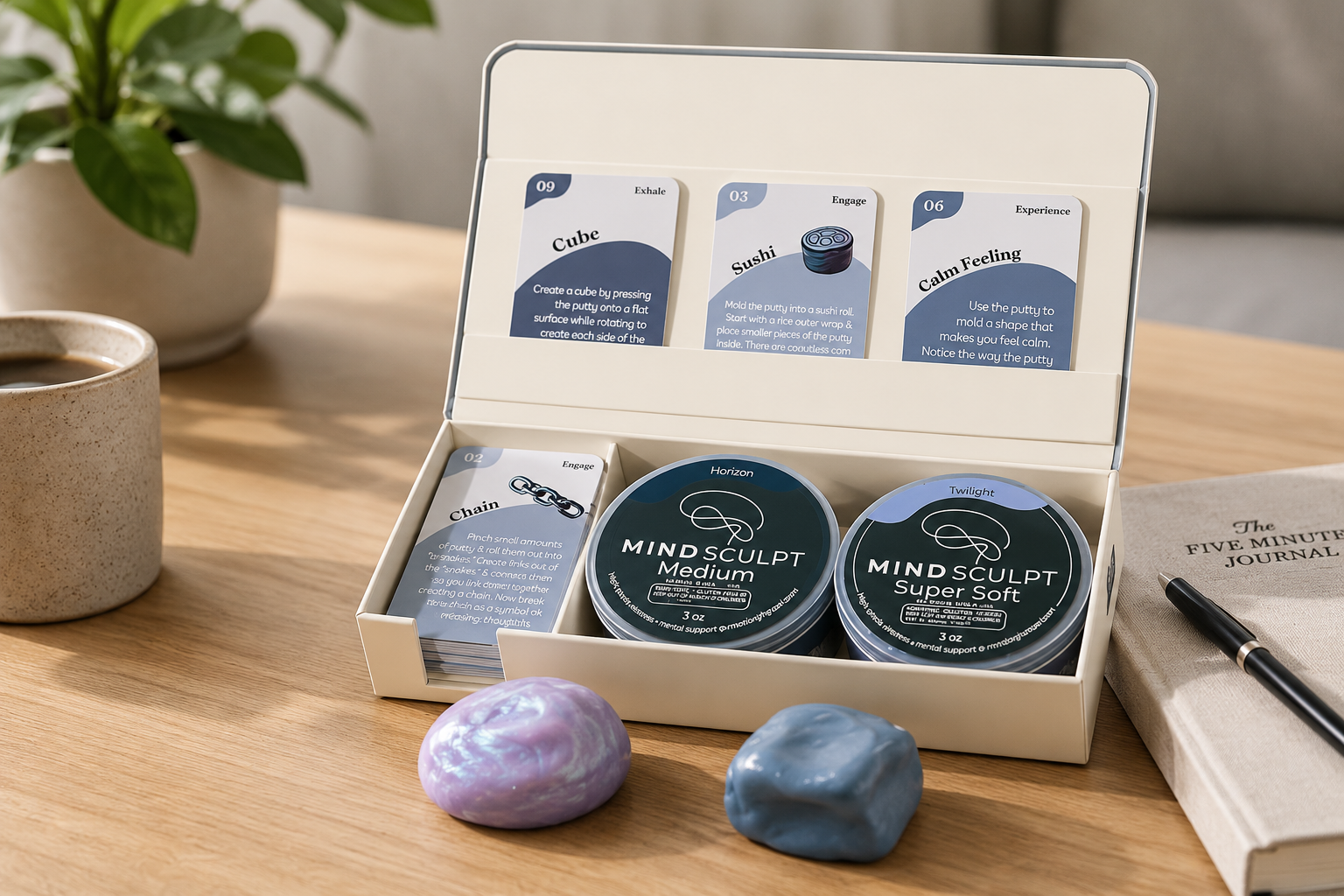
If you want to create a tactile mindfulness or reset habit, MindSculpt by Mindsight gives that routine a physical cue.
MindSculpt combines reusable sensory putty with guided mindfulness exercises.
The putty can be squeezed, stretched, molded, or shaped while you direct your attention toward the physical sensation and the exercise you are practicing.
The MindSculpt Kit currently includes 52 guided exercises, with activities designed around areas such as breathing, mindfulness, focus, and stress relief.
That makes it particularly useful for creating a small repeatable ritual.
Instead of telling yourself:
- “I should practice mindfulness more.”
You could create a specific habit:
- “After I finish lunch, I will use MindSculpt for five minutes.”
- “After I close my laptop, I will do one MindSculpt exercise before starting my evening.”
The physical product also becomes a visible reminder.
Leave it somewhere connected to the routine you want to create, such as your desk or another designated reset space.
The objective is not to depend on a product for motivation.
It is to use a consistent cue and a simple activity to make the desired behavior easier to repeat.
MindSculpt
A reusable sensory putty kit with guided mindfulness exercises for focus, breathing, stress relief, and simple daily reset rituals.
Explore MindSculptFrequently Asked Questions
How do you build habits that actually stick?
Start with a behavior small enough to repeat consistently, connect it to a clear cue, make it easy to perform, and shape your environment around it. Focus on repetition before increasing the difficulty or duration.
How long does it take to build a habit?
There is no universal number of days that guarantees a behavior will become automatic. Habit formation varies depending on the person, behavior, circumstances, and consistency of repetition. Instead of counting toward a magic deadline, focus on creating a routine you can maintain.
Why do I keep failing at new habits?
The problem may be the structure rather than the goal. Habits can be difficult to maintain when they are too ambitious, lack clear cues, require too much effort, or do not fit naturally into your existing routine.
Should I build multiple habits at once?
You can, but starting with one important behavior often makes the process easier. Once that behavior feels stable, you can gradually introduce another rather than trying to overhaul your entire routine at once.
What should I do if I miss a day?
Return to the habit at the next realistic opportunity. Missing one repetition does not mean you need to abandon the routine. If you keep missing it, reduce the habit or change its timing and cue.
How can I make mindfulness a daily habit?
Start with a very short practice and attach it to something you already do every day. For example, practice slow breathing after making coffee or spend several minutes with a tactile mindfulness activity after finishing work.
Final Thoughts
Better habits rarely begin with a complete transformation.
They begin with repeatable actions.
- Start smaller.
- Choose a clear cue.
- Make the behavior easy.
- Change your environment.
- Expect imperfect days.
- Return when you miss one.
- Then repeat.
Instead of asking yourself how much you can change this week, ask a better question:
What small action could I realistically continue doing next month?
That is where sustainable routines begin.
If a tactile mindfulness habit fits the routine you want to build, MindSculpt by Mindsight can provide a physical cue and guided structure for a short daily reset.
Start with a few minutes.
Give the habit a consistent place in your day.
Then allow repetition to do what motivation alone often cannot.
Explore MindSculpt
Build a small tactile reset habit with reusable sensory putty and guided mindfulness exercises.
Shop MindSculpt