How to Stay Focused When Your Brain Feels All Over the Place
Some days your brain feels like it has too many tabs open. You sit down to work, but your thoughts jump everywhere. You remember one task, then another, then a message, then something you forgot to do yesterday.
When your mind feels scattered, focus can feel almost impossible. The answer is not always to push harder. Often, the better place to begin is by calming the noise, reducing distractions, and giving your attention one clear place to land.
Table of Contents
- Why Your Brain Feels Scattered
- The Difference Between Being Busy and Being Focused
- Why Stress Makes Focus Harder
- How Your Environment Affects Concentration
- Simple Ways to Reset Your Attention
- Why Breathing Helps Calm Mental Noise
- How Tactile Tools Support Focus
- Using Breathing Buddha and Mind Sculpt for Focus
- Final Thoughts
Why Your Brain Feels Scattered
Some days, your brain feels like it has too many tabs open.
You sit down to work, but your thoughts jump everywhere. You remember an email you forgot to answer. You think about a task you need to finish later. You check one notification, then another. Before you know it, your attention is split across ten different things.
This kind of scattered focus is common, especially when your day is full of screens, deadlines, messages, and constant decisions.
The problem is not always that you are unmotivated. Often, your brain is simply overloaded.
When there is too much input, your mind has a harder time choosing one place to land. Everything feels important. Everything feels urgent. Even simple tasks can start to feel heavier than they should.
The first step is not forcing yourself to focus harder. It is helping your brain feel steady enough to focus at all.
The Difference Between Being Busy and Being Focused
Being busy and being focused are not the same thing.
Busy means you are doing a lot. Focused means your attention is directed toward one clear thing.
You can answer messages, check emails, open tabs, make lists, and still end the day feeling like you did not make real progress. That is because scattered activity can feel productive while still draining your attention.
Focused work feels different. It has a clear direction. You know what you are doing, why you are doing it, and what needs to happen next.
When your brain feels all over the place, it often helps to pause and ask:
What is the one thing I need to focus on right now?
Not the whole list. Not the whole week. Not every open loop in your brain.
Just one thing.
That question gives your attention a landing spot.
Why Stress Makes Focus Harder
Stress changes the way your brain works.
When your nervous system feels activated, your brain becomes more alert and reactive. This is useful when there is a real emergency, but it is not helpful when you are trying to write, study, plan, create, or think deeply.
Stress can make your attention jump from one thing to another. You may find yourself checking your phone more often, switching tasks quickly, or avoiding work that requires deeper concentration.
You may also feel:
- Restless
- Tense
- Mentally noisy
- Easily distracted
- Unable to sit still
- Busy but not productive
- Overwhelmed by simple tasks
This happens because your body is in a state of alertness. Your brain is scanning, not settling.
To improve focus, you often need to calm the body first. Once the nervous system begins to settle, your attention becomes easier to guide.
How Your Environment Affects Concentration
Your environment has a quiet but powerful effect on your focus.
A cluttered desk, loud background noise, open phone, bright screen, or messy room can all compete for attention. Even when you are not consciously thinking about these things, your brain is still processing them.
That extra processing creates mental load.
A calm workspace gives your brain fewer distractions to sort through. It helps your attention stay with the task instead of bouncing around the room.
To make your environment more focus-friendly, start with small changes:
- Clear your desk before beginning work.
- Close extra tabs.
- Put your phone out of reach.
- Lower unnecessary noise.
- Keep only the tools you need nearby.
- Add one calming object or sensory tool.
You do not need a perfect workspace. You just need a space that makes focus easier instead of harder.
Simple Ways to Reset Your Attention
When your brain feels scattered, a full reset can feel impossible. But small resets can help you return to the moment.
Try one of these:
- Take three slow breaths.
- Close your eyes for ten seconds.
- Write down every loose thought on paper.
- Choose one task and remove everything else from view.
- Stand up and stretch for one minute.
- Put your phone in another room.
- Set a short timer for focused work.
- Use a tactile tool to ground restless energy.
The goal is not to become perfectly calm before you start. The goal is to give your attention enough structure to begin again.
A reset does not have to take long. Sometimes one quiet minute can help your brain shift from scattered to steady.
Why Breathing Helps Calm Mental Noise
Your breath is directly connected to your nervous system.
When you are stressed or distracted, your breathing often becomes shallow or irregular. This can keep your body in a state of alertness, which makes focus harder.
Slowing your breath sends a different signal to the body. It tells your nervous system that you are safe enough to settle.
A simple breathing reset can help:
- Reduce racing thoughts
- Lower physical tension
- Calm mental urgency
- Support smoother task transitions
- Give your attention a clear anchor
Try this before starting focused work:
- Inhale slowly.
- Exhale longer than you inhale.
- Repeat for one minute.
- Then return to one clear task.
Breathing will not remove every distraction, but it can help your brain work from a calmer state.
How Tactile Tools Support Focus
Some people focus better when their hands have something to do.
This does not mean they are distracted. For many people, small hand movements help release restless energy and make it easier to stay present.
Tactile tools can be helpful because they give the body a simple, physical outlet. Instead of tapping, scrolling, clicking, or reaching for your phone, your hands have something grounding to return to.
A good tactile tool should feel:
- Quiet
- Soft
- Simple
- Portable
- Non-distracting
- Calming to use
The point is not to play with something so much that it steals your attention. The point is to support the body so the mind can stay with the task.
Using Breathing Buddha and Mind Sculpt for Focus
The Breathing Buddha and Mind Sculpt by Mindsight support focus in different but complementary ways.
The Breathing Buddha gives your breath a visual rhythm to follow. When your mind feels scattered, you can use it for a short breathing reset before starting work, during a break, or between tasks.
It can be helpful when:
- You feel mentally overwhelmed
- You are about to start deep work
- You need to calm racing thoughts
- You are transitioning between meetings
- You want a screen-free focus reset
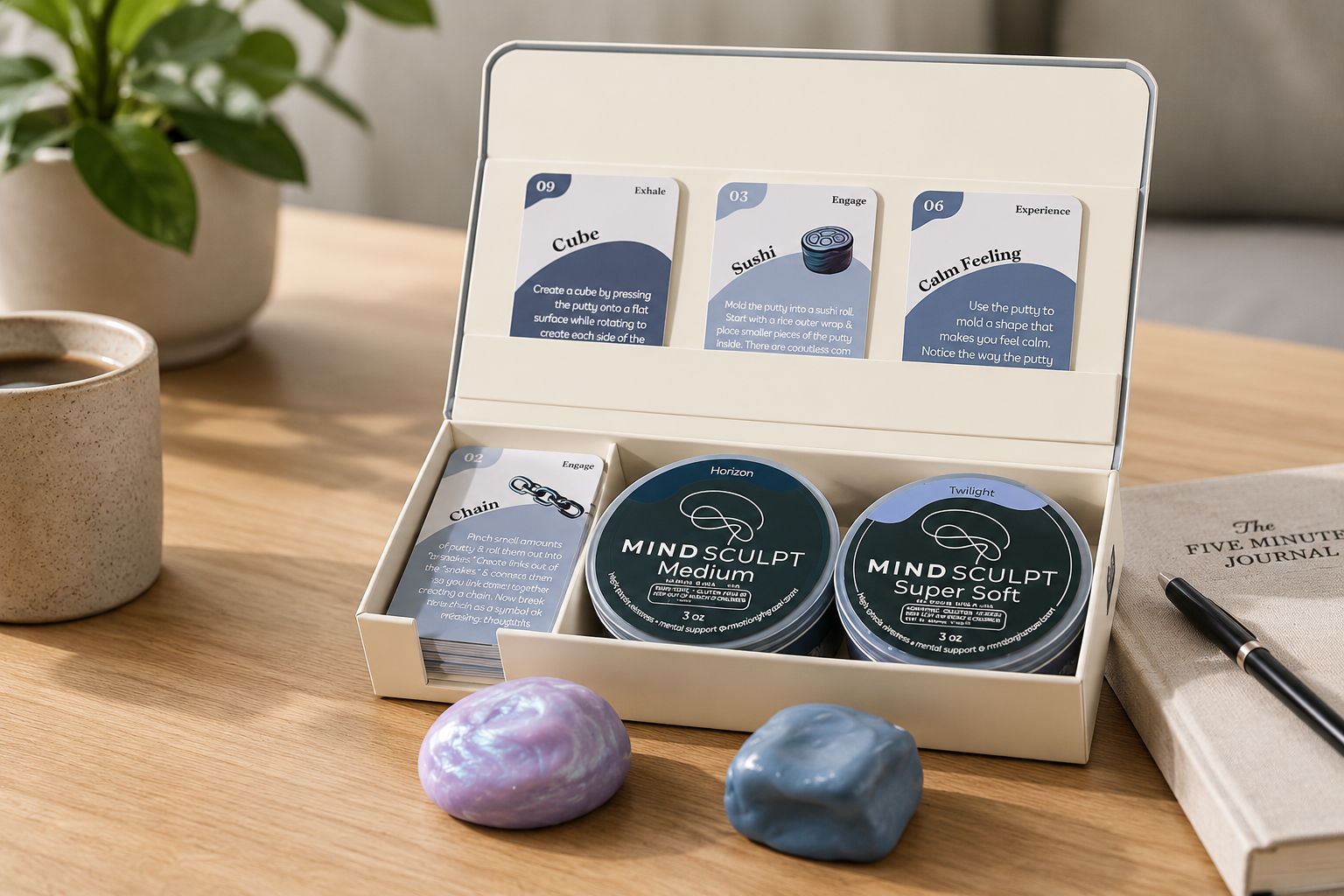
Mind Sculpt supports focus through tactile grounding. Stretching, squeezing, shaping, or rolling it gives restless hands a calm outlet during work or study.
It can be helpful during:
- Meetings
- Long work sessions
- Creative thinking
- Study blocks
- Stressful moments
- Periods of mental fatigue
Together, they create a simple focus support system: one tool helps regulate your breath, and the other helps ground your body.
Breathing Buddha
A screen-free visual breathing guide that helps create a calm rhythm for focus, task transitions, and mental resets.
Explore the Breathing BuddhaMind Sculpt
A tactile focus and stress relief tool that gives restless hands a calm outlet during work, study, and creative thinking.
Explore Mind SculptFinal Thoughts
When your brain feels all over the place, the answer is not always to push harder.
Sometimes, focus improves when you slow down first.
A scattered mind often needs fewer inputs, clearer boundaries, and a calmer body. By resetting your breath, clearing your space, choosing one task, and giving restless energy a healthy outlet, you can make focus feel less forced.
Start small.
Take one breath. Clear one surface. Choose one task. Give your mind one place to land.
Focus does not have to feel like a battle. With the right support, it can feel like coming back to yourself.