The Simple Breathing Habit That Helps You Refocus During the Day
When your focus starts slipping, a simple breathing reset can help your mind slow down and return to the task in front of you.
You do not always need a long break, a perfect routine, or a completely quiet room. Sometimes, one minute of slower breathing can help reduce mental noise, calm your nervous system, and give your attention a clear place to land.
Table of Contents
Why Focus Slips During the Day
Focus does not usually disappear all at once.
It slips away in tiny pieces.
You answer one message. You check one notification. You open one extra tab. You think of something you forgot. You switch tasks. You try to come back, but your attention feels scattered, like it has little crumbs all over the desk.
This is normal.
Your brain is constantly responding to information during the day. Work, school, messages, errands, conversations, decisions, screens, and background stress all compete for attention.
After a while, your mind can start to feel noisy.
You may notice:
- Rereading the same sentence
- Switching tabs without thinking
- Checking your phone during small pauses
- Forgetting what you were about to do
- Feeling busy but not productive
- Avoiding the task that needs deeper focus
- Feeling mentally tired even when the day is not over
When this happens, you do not always need a long break.
Sometimes you need a small reset that helps your attention come back to one place.
Why Your Brain Needs Transition Moments
Many people move from one task to the next without any real transition.
A meeting ends, and you open email. An email ends, and you check a message. A message ends, and you jump into a task. A task ends, and you grab your phone.
Your brain never gets a clean doorway between activities.
Without transition moments, the mind keeps carrying pieces of the last task into the next one. That can make focus feel messy.
A transition moment helps you close one thing before beginning another.
It can be as simple as:
- Taking three slow breaths
- Writing down the next task
- Closing extra tabs
- Standing up for one minute
- Looking away from your screen
- Putting your phone out of reach
- Following a breathing cue
These little pauses may seem small, but they help your brain shift gears.
Think of it as wiping the mental windshield before driving into the next part of the day.
How Stress Makes Attention Feel Scattered
Stress can make focus harder because it puts your body into alert mode.
When your nervous system feels activated, your brain becomes more reactive. It scans for what needs attention next. That can be helpful during real urgency, but not when you are trying to write, study, plan, read, create, or think clearly.
Stress may make you:
- Check your phone more often
- Move quickly between tasks
- Avoid difficult work
- Feel restless at your desk
- React faster to notifications
- Lose patience more easily
- Feel mentally crowded
When your body is tense, your attention often becomes harder to guide.
That is why calming the body can help calm the mind.
You do not need to become completely relaxed before focusing. You simply need to create enough steadiness for your brain to land.
A breathing habit can help with that.
The Simple Breathing Habit to Try
Here is a simple breathing reset you can use during the day:
- Pause what you are doing.
- Relax your shoulders.
- Inhale slowly through your nose.
- Exhale gently and let the exhale be a little longer.
- Repeat for one minute.
- Then choose one task to return to.
That is it.
No complicated routine. No perfect setup. No need to become a meditation wizard in the middle of your workday.
The goal is to interrupt scattered momentum.
Your breath gives your attention something simple to follow. Instead of chasing every thought, message, and open loop, your mind gets one steady rhythm.
After one minute, ask:
What is the next right task?
Not the entire list.
Just the next task.
That small question helps your attention land somewhere useful.
Why Slow Breathing Helps You Refocus
Your breath is connected to your nervous system.
When you are stressed, rushed, or overstimulated, your breathing can become shallow or irregular. This can keep your body feeling alert, even if you are sitting still.
Slower breathing sends a calmer signal.
It tells your body that it does not have to keep bracing. It helps create a small pause between stress and response.
A breathing reset can help:
- Reduce mental noise
- Lower physical tension
- Create a calmer task transition
- Interrupt phone-checking habits
- Support clearer thinking
- Help your body feel less rushed
- Give your attention a simple anchor
The breath does not erase your responsibilities.
It helps you return to them with a steadier mind.
That is the quiet usefulness of this habit. It is small enough to repeat, but strong enough to change the feeling of the next few minutes.
When to Use a Breathing Reset During the Day
The best time to use a breathing reset is before your attention fully falls apart.
Try using it:
- Before starting work
- Before a meeting
- After a stressful email
- Between tasks
- After checking your phone
- Before studying
- Before writing
- When you feel mentally scattered
- When you are about to procrastinate
- When your body feels tense
- Before making a decision
- At the end of a work block
You can also attach the habit to something you already do.
For example:
- Before opening your laptop, breathe for one minute.
- After every meeting, breathe before checking messages.
- Before lunch, breathe and reset your body.
- Before bed, breathe to close the day.
- Before deep work, breathe and choose one task.
Habits are easier when they have a home.
Choose one part of your day where focus often slips and place the breathing reset there.
Using Breathing Buddha for Daily Focus Breaks
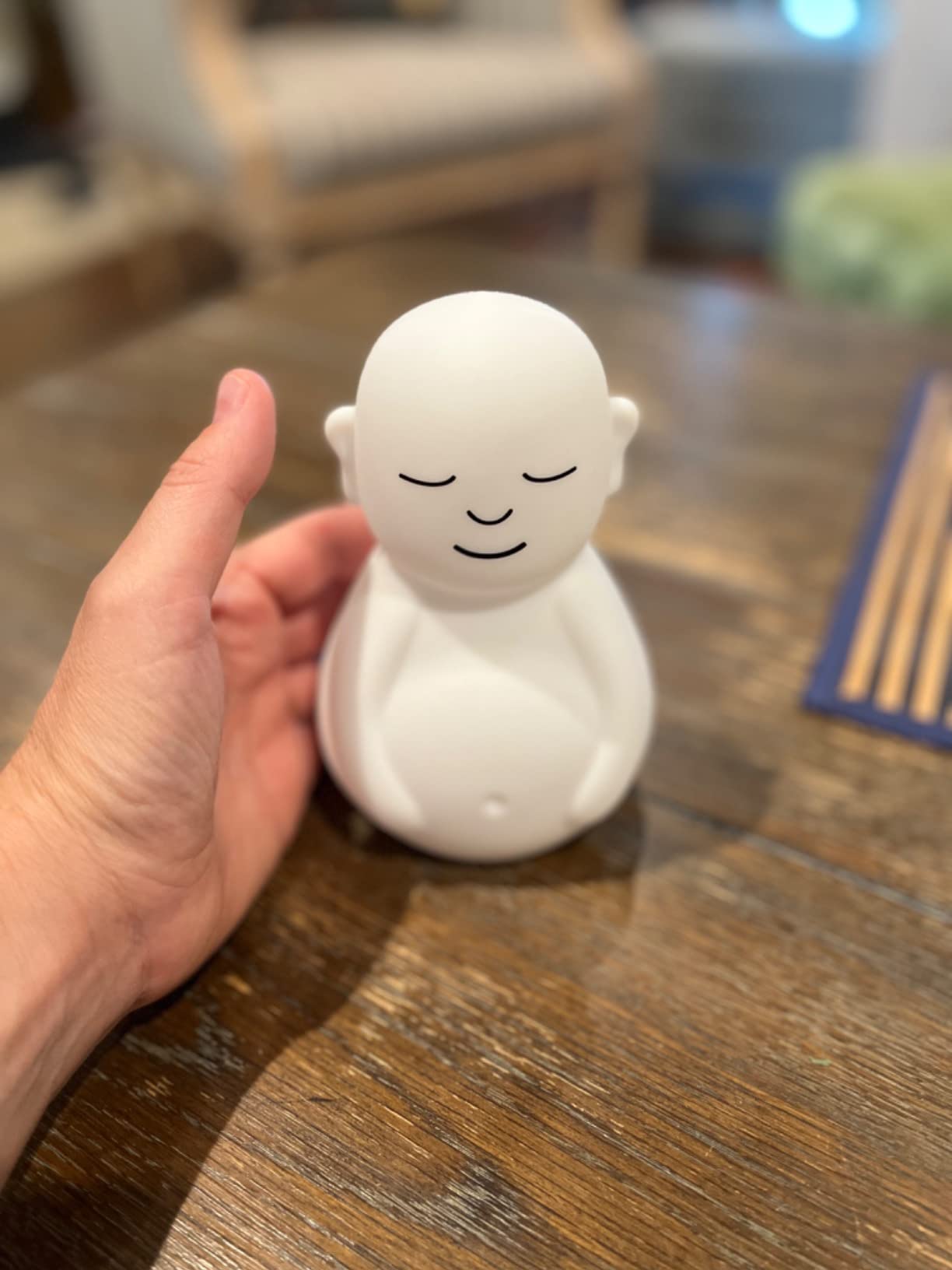
The Breathing Buddha by Mindsight can help make this daily breathing habit easier to follow.
Instead of using your phone, an app, or a timer, the Breathing Buddha gives your breath a visual rhythm. Its light expands and fades so you can follow the cue and slow your breathing without overthinking it.
This can be helpful if your mind feels scattered and you do not want to add another screen to your reset.
You can use the Breathing Buddha:
- At your desk before deep work
- Between meetings
- During a midday reset
- Before studying
- After a stressful message
- When your thoughts feel loud
- During a screen-free focus break
- Before bedtime wind-down
The Breathing Buddha is a guided breathing light for reducing stress, improving focus, and promoting relaxation. It includes an expanding and fading LED breath light, USB-C rechargeability, optional sound mode, and multiple guided breathing modes.
It can become a small visual cue on your desk or bedside table, reminding you to pause before your mind runs into the next thing.
Breathing Buddha
A screen-free guided breathing light that gives your breath a simple visual rhythm for focus breaks, relaxation, mindfulness, and calmer transitions during the day.
Explore the Breathing BuddhaFinal Thoughts
Focus does not always come back by forcing yourself to try harder.
Sometimes it comes back when you slow down long enough to give your mind one clear place to land.
A simple breathing habit can help you reset during the day. It gives your nervous system a calmer signal, your attention a steady anchor, and your brain a small doorway between tasks.
Start with one minute.
Pause. Breathe. Exhale slowly. Choose one task.
You do not need a perfect routine to feel more focused.
You just need one small moment where your mind can stop scattering and come back.