Feeling Restless While Working? Here’s What Your Body Might Need
Restlessness during work does not always mean you are distracted. Sometimes your body needs a better outlet for stress, energy, and focus.
Long work blocks, screen-heavy tasks, meetings, messages, and mental load can make your body feel unsettled even when you are trying to concentrate. A few simple resets and tactile tools can help give that restless energy somewhere useful to go.
Table of Contents
- Why Restlessness Shows Up During Work
- Why Sitting Still Does Not Always Mean Focus
- How Stress and Mental Load Create Restless Energy
- The Difference Between Distracting Movement and Supportive Movement
- Why Your Hands Want Something to Do
- Simple Ways to Work With Restlessness Instead of Fighting It
- Using MindSculpt for Restless Hands and Focus
- Final Thoughts
Why Restlessness Shows Up During Work
Restlessness can show up at the most inconvenient times.
You sit down to work, answer emails, study, write, plan, or join a meeting, and suddenly your body does not want to sit still. Your fingers tap. Your legs bounce. You click your pen. You reach for your phone. You open another tab. You shift in your chair like your desk has become a tiny waiting room for your nervous system.
This can feel frustrating, especially when you are trying to focus.
But restlessness does not always mean you are lazy, distracted, or bad at concentrating.
Sometimes it means your body has energy it does not know where to put.
Work often asks your mind to stay active while your body stays still. That mismatch can make restlessness build quickly, especially during long tasks, meetings, screen-heavy days, or stressful moments.
Your body may be asking for movement, sensory input, or a healthier way to release tension.
The goal is not always to force stillness. Sometimes the goal is to give restlessness a better job.
Why Sitting Still Does Not Always Mean Focus
Many people were taught that focus looks quiet.
Sit still. Keep your hands down. Stop moving. Pay attention.
But focus does not look the same for everyone.
Some people think more clearly when their hands are moving. Some people listen better when they can gently fidget. Some people stay more present when their body has a small, repetitive outlet.
Stillness and focus are not always the same thing.
You can sit perfectly still and feel mentally scattered. You can also be gently moving your hands and still be fully present.
The key is whether the movement supports attention or steals attention.
Supportive movement helps your body regulate without pulling your mind away from the task. Distracting movement pulls you into a different activity completely.
For example, squeezing a tactile tool during a meeting may help your body settle. Scrolling your phone during that same meeting may pull your attention into a digital rabbit hole wearing office shoes.
The difference matters.
How Stress and Mental Load Create Restless Energy
Restlessness often increases when your brain is carrying too much.
You may have deadlines, messages, decisions, unfinished tasks, notifications, meetings, family responsibilities, or background worries all competing for space in your mind.
When mental load builds, the body can respond physically.
You may notice:
- Tapping fingers
- Bouncing legs
- Tight shoulders
- Clenched jaw
- Frequent phone checking
- Opening tabs without thinking
- Difficulty staying with one task
- Feeling wired but tired
- A strong urge to get up or avoid the task
This does not always mean you need more discipline.
It may mean your nervous system is activated.
When your body feels stressed, it looks for ways to release energy. If you do not give it a healthy outlet, it may choose the easiest one nearby. Often, that means your phone, extra tabs, snacks, or random desk clutter.
A better approach is to notice the restlessness early and give it a simple, grounding outlet.
The Difference Between Distracting Movement and Supportive Movement
Not all movement affects focus the same way.
Some movement helps you stay with the task. Other movement pulls you away from it.
Distracting movement often creates more input, more decisions, or more attention switching.
Examples include:
- Picking up your phone
- Opening social media
- Checking email repeatedly
- Clicking through random tabs
- Leaving your desk without intention
- Rearranging things instead of starting
- Multitasking to avoid one difficult task
Supportive movement is different.
It gives your body sensory input without hijacking your attention.
Examples include:
- Stretching your hands
- Rolling your shoulders
- Taking a slow breath
- Standing for a minute
- Using a tactile focus tool
- Squeezing or shaping putty
- Taking a short movement break
- Writing loose thoughts on paper
Supportive movement helps your nervous system settle enough for your mind to return.
The goal is not to remove all movement.
The goal is to choose movement that supports the work you want to do.
Why Your Hands Want Something to Do
Hands are often the first place restlessness appears.
You may tap, twist, click, scroll, pick, pull, squeeze, or reach for whatever is nearby. Your hands are looking for input.
That input can be calming when it is simple and repetitive.
Tactile feedback gives your body something concrete to feel. This can help bring attention back into the present moment, especially when your mind feels scattered or overloaded.
That is why tactile tools can be helpful during desk work.
They give your hands something to do without requiring a screen, app, notification, or new stream of information.
A good tactile tool should be:
- Quiet
- Portable
- Easy to use
- Non-disruptive
- Comfortable in the hand
- Calming rather than distracting
- Simple enough to use during work
When your hands have a healthy outlet, your phone may become less tempting.
Your body still gets input, but your attention stays closer to the task.
Simple Ways to Work With Restlessness Instead of Fighting It
Fighting restlessness can make it feel louder.
Instead of getting frustrated, try treating it like a signal.
Ask: What does my body need right now?
Maybe it needs movement. Maybe it needs a breath. Maybe it needs less stimulation. Maybe it needs a short reset before continuing.
Try these simple workday resets:
- Take three slow breaths.
- Stretch your hands and wrists.
- Stand up for one minute.
- Write down the task you are avoiding.
- Put your phone out of reach.
- Close extra browser tabs.
- Use a tactile tool during meetings.
- Take a short walk between work blocks.
- Clear one small area of your desk.
- Drink water slowly.
- Set a timer for a short focus session.
- Give your hands something calming to hold.
The goal is not to become perfectly still.
The goal is to guide restless energy into something that supports you.
Sometimes your body is not trying to interrupt your focus.
It is trying to help you regulate.
Using MindSculpt for Restless Hands and Focus
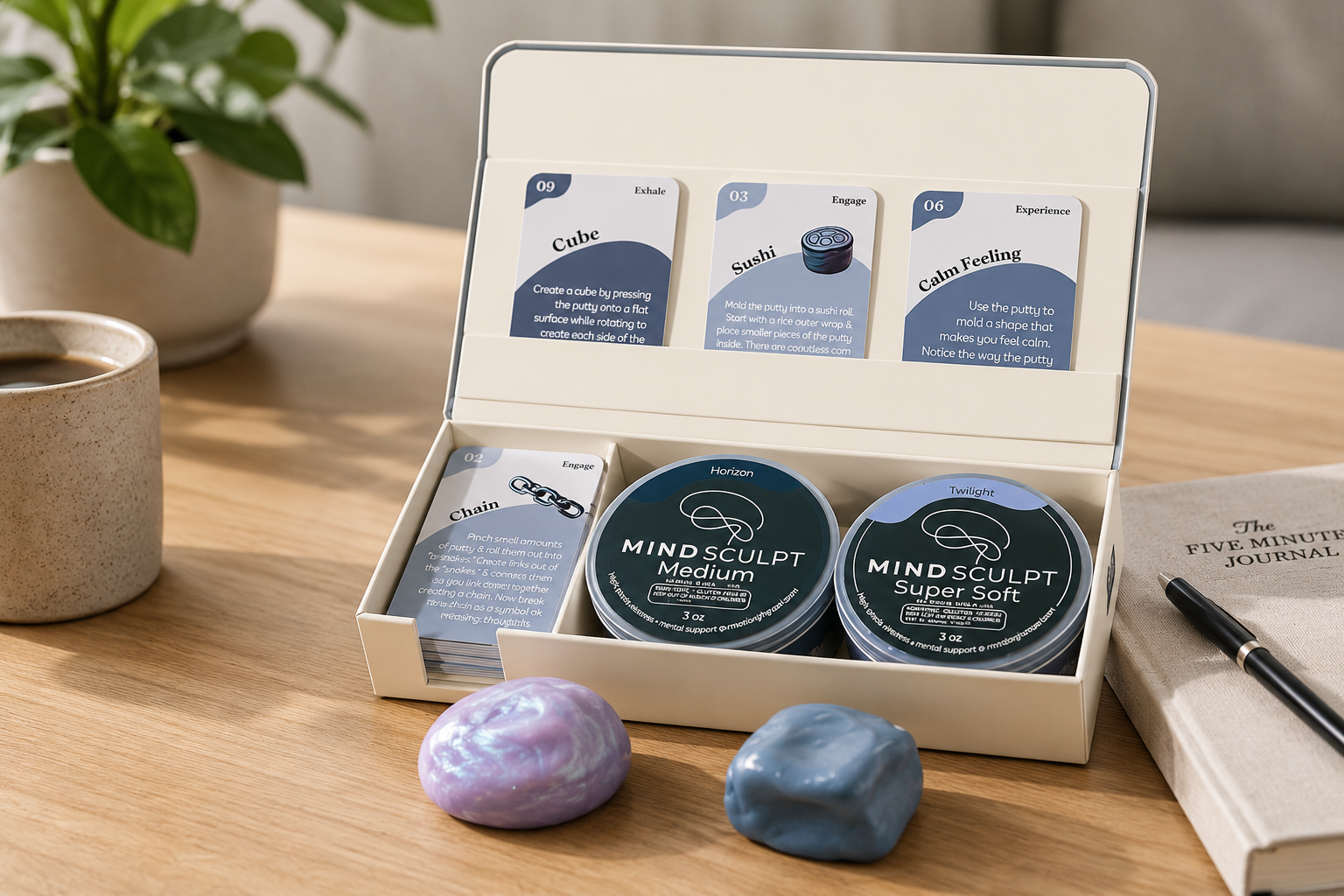
MindSculpt by Mindsight is designed as a tactile focus and stress relief tool for people who need a quiet, physical outlet during work, study, or stressful moments.
MindSculpt includes premium high-grade silicone putty and guided calming exercises. It can be used as a sensory fidget tool for stress relief, focus, mindfulness practice, and screen-free support during long work blocks.
You can use MindSculpt when:
- Your hands feel restless
- You want to scroll but need to focus
- You are sitting through a long meeting
- You feel mentally overloaded
- You need a screen-free reset
- You are brainstorming or planning
- You are trying to stay present during work
- You need a calming sensory cue nearby
Stretch it. Squeeze it. Roll it. Shape it. Press it slowly while you breathe.
The point is not to distract yourself from work.
The point is to give your body a steady outlet so your mind has a better chance of staying with the task.
MindSculpt
A tactile focus and stress relief tool that gives restless hands a quiet, grounding outlet during work, study, meetings, and stressful moments.
Explore MindSculptFinal Thoughts
Feeling restless while working does not mean something is wrong with you.
Your body may simply need support.
Long work blocks, screens, stress, and mental load can create energy that needs somewhere to go. When you give that energy a healthy outlet, it becomes easier to stay present.
Do not force your body into stillness if stillness is making focus harder.
Try a small reset. Stretch your hands. Move your phone away. Take a breath. Give your hands something grounding to do.
Restlessness does not have to pull you away from your work.
With the right support, it can become a signal that helps you come back.