Feeling Stressed at Your Desk? Small Tools That Help You Calm Down Fast
Desk stress can build quietly during the workday. One email becomes five. One message becomes a thread. One tab becomes a whole little forest of unfinished tasks.
Before you realize it, your shoulders are tight, your breathing is shallow, and your brain feels like it is trying to carry too much at once.
The good news is that calming down does not always require a long break. Small desk tools and simple resets can help reduce tension, support focus, and make your workspace feel more supportive.
Table of Contents
- Why Desk Stress Builds So Quickly
- How Stress Shows Up While You Work
- Why Your Workspace Affects Your Nervous System
- The Problem With Pushing Through Stress
- Small Resets That Help You Calm Down Fast
- Why Breathing Helps During Work Stress
- How Tactile Tools Release Restless Energy
- Using Breathing Buddha and Mind Sculpt at Your Desk
- Final Thoughts
Why Desk Stress Builds So Quickly
Desk stress can build before you even realize it.
You sit down with a plan for the day. Then the emails arrive. Messages start popping up. A task takes longer than expected. A meeting gets added. Your phone buzzes. Your tabs multiply like tiny digital rabbits.
By lunchtime, your body may already feel tense.
The tricky thing about desk stress is that it often builds quietly. It does not always feel like a dramatic moment. It may show up as tight shoulders, shallow breathing, irritability, restlessness, or a sense that your brain is trying to carry too many things at once.
Your desk becomes the place where everything happens: work, problem-solving, communication, pressure, decisions, deadlines, and sometimes even meals.
That is a lot for one little rectangle of space.
Creating calming support at your desk can help your body and mind reset during the day instead of waiting until stress becomes overwhelming.
How Stress Shows Up While You Work
Stress is not always obvious. Sometimes it looks like productivity.
You may answer messages quickly, jump between tasks, move fast, and look busy from the outside. But inside, your attention may feel scattered and your body may feel activated.
Common signs of desk stress include:
- Tight shoulders
- Clenched jaw
- Shallow breathing
- Fast thoughts
- Restless hands
- Frequent phone checking
- Difficulty focusing
- Task switching
- Irritability
- Mental fatigue
- Feeling overwhelmed by simple tasks
These signs are your body’s way of asking for support.
When stress builds, your nervous system shifts into alert mode. That can make it harder to think clearly, stay patient, and focus on one task at a time.
The goal is not to avoid all stress. Work will always come with demands. The goal is to create small resets that help you return to a steadier state throughout the day.
Desk stress does not always need a big solution. Sometimes your nervous system just needs one small pause before the next thing.
Why Your Workspace Affects Your Nervous System
Your workspace sends signals to your brain all day long.
A cluttered desk can create visual noise. Bright lighting can feel harsh. Constant notifications can keep your body alert. A phone within reach can pull your attention away again and again.
Even when you are not consciously thinking about these things, your brain is still processing them.
This creates mental load.
A calm workspace gives your nervous system fewer signals to filter. It can help your body feel more settled and your mind feel less crowded.
A supportive desk setup might include:
- A cleaner surface
- Softer lighting
- Fewer visible distractions
- A phone boundary
- A simple breathing cue
- A tactile grounding tool
- One calming object nearby
- A short reset ritual between tasks
You do not need a perfect office. You need a workspace that works with your body instead of keeping it in constant alert mode.
The Problem With Pushing Through Stress
Many people respond to desk stress by pushing harder.
They ignore tension, skip breaks, answer one more email, open another tab, and tell themselves they will relax later.
But pushing through stress does not always make you more productive. Sometimes it keeps your nervous system activated for longer.
When your body stays in stress mode, focus becomes harder. You may start making more mistakes, losing patience, avoiding harder tasks, or feeling exhausted even when you have been sitting all day.
Pushing through can also make stress feel normal.
You may not notice how tense you are until the end of the day, when your body finally has a moment to speak up.
Small resets help interrupt that pattern.
Instead of waiting until stress becomes too much, you give your body quick moments of regulation throughout the day.
Small Resets That Help You Calm Down Fast
A calming reset does not have to take 30 minutes. It does not need candles, silence, or a perfectly peaceful room.
At your desk, a reset can be simple.
Try one of these:
- Take three slow breaths.
- Drop your shoulders.
- Relax your jaw.
- Close your eyes for ten seconds.
- Stretch your hands.
- Stand up and shake out tension.
- Clear one small area of your desk.
- Put your phone out of reach.
- Write down the one task you are doing next.
- Use a tactile tool for one minute.
- Follow a visual breathing guide.
These small actions create a pattern interrupt. They tell your body, “We are not trapped in the stress loop. We can pause.”
Even a brief pause can change the quality of your next few minutes.
That matters because workdays are built from small moments. When you add more regulated moments, the whole day can feel different.
Why Breathing Helps During Work Stress
Breathing is one of the fastest ways to communicate with your nervous system.
When you are stressed, your breath often becomes shallow or quick. This can keep your body in alert mode.
When you slow your breath, especially your exhale, you help signal that your body is safe enough to settle.
A simple breathing reset can help:
- Lower physical tension
- Reduce racing thoughts
- Create a calmer transition between tasks
- Support clearer thinking
- Improve focus
- Help your body leave reactive mode
Try this at your desk:
- Inhale gently.
- Exhale slowly.
- Repeat for one minute.
- Then choose one task to return to.
You do not need to breathe perfectly. You just need to give your nervous system a slower rhythm to follow.
How Tactile Tools Release Restless Energy
Stress often shows up in the hands.
You may tap your fingers, click a pen, pick at your nails, scroll your phone, or keep reaching for random objects on your desk.
This is not always a bad thing. Your body may be trying to release energy and stay regulated.
Tactile tools give that energy a healthier place to go.
A good tactile tool can help you:
- Redirect restless movement
- Stay present during meetings
- Reduce the urge to scroll
- Support focus during long work blocks
- Create a calming sensory rhythm
- Release tension without leaving your desk
The key is choosing something that supports attention instead of stealing it.
Soft, quiet, repetitive sensory input can help your body settle while your mind stays engaged.
Using Breathing Buddha and Mind Sculpt at Your Desk
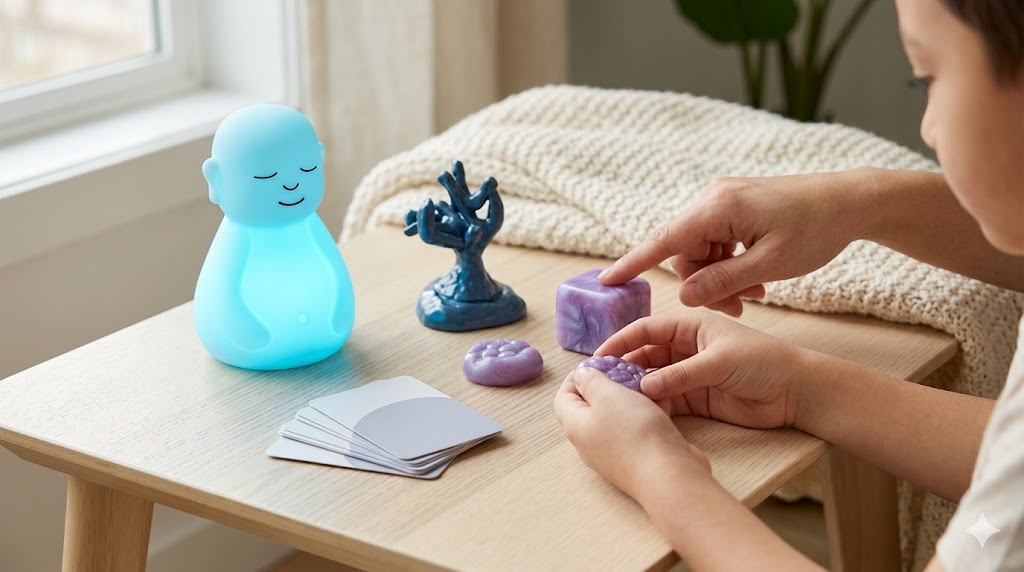
The Breathing Buddha and Mind Sculpt by Mindsight can both support calmer workdays in simple, screen-free ways.
The Breathing Buddha is a visual breathing guide. It gives your breath a rhythm to follow without needing an app, timer, or phone. During a stressful workday, it can help you pause, breathe, and reset before returning to your next task.
You can use the Breathing Buddha:
- Before starting deep work
- Between meetings
- After a stressful email
- During a screen break
- Before a difficult conversation
- When your thoughts feel scattered
Mind Sculpt is a tactile tool that gives restless hands something calming to do. Stretching, squeezing, shaping, or rolling it can help redirect nervous energy during work, meetings, or moments of mental fatigue.
You can use Mind Sculpt:
- During meetings
- While brainstorming
- During long study or work sessions
- When your hands feel restless
- When stress makes you want to scroll
- During creative thinking
Together, these tools support two common stress pathways: breath and touch. One helps your body find a calmer rhythm. The other gives restless energy a grounding outlet.
Breathing Buddha
A screen-free visual breathing guide that helps create a calm rhythm for desk stress, focus resets, and smoother transitions between tasks.
Explore the Breathing BuddhaMind Sculpt
A tactile focus and stress relief tool that gives restless hands a quiet, grounding outlet during work, meetings, and stressful moments.
Explore Mind SculptFinal Thoughts
Desk stress does not always arrive loudly. Sometimes it builds quietly through small interruptions, constant decisions, clutter, notifications, and the pressure to keep going.
But you do not have to wait until the end of the day to calm down.
Small tools and small resets can help your nervous system return to a steadier state while you work. A few slow breaths, a calmer desk, a physical grounding tool, or a simple pause between tasks can change the texture of your day.
The Breathing Buddha and Mind Sculpt offer screen-free ways to support focus, calm, and regulation right at your desk.
Start small.
Before your next task, take one breath. Let your shoulders drop. Give your hands somewhere calm to land.
Sometimes the best productivity tool is the one that helps your body stop bracing.