Why Your Mind Feels Tired Even When Your Body Isn’t
Mental tiredness can feel heavy, even when your body still has energy. You may be able to walk, clean, cook, work, or run errands, but your mind feels foggy, crowded, and completely done.
This kind of mental fatigue often happens when your brain has been processing too much for too long. The good news is that small calming habits, fewer inputs, and simple breathing resets can help your mind feel clearer and more grounded.
Table of Contents
- Why Mental Tiredness Feels So Heavy
- The Difference Between Physical Tiredness and Mental Fatigue
- Why Too Much Input Drains Your Brain
- How Decision Fatigue Makes You Feel Overloaded
- Why Your Mind Needs Quiet, Not More Stimulation
- Simple Ways to Give Your Brain a Reset
- How Breathing Helps Reduce Mental Fatigue
- Using Breathing Buddha for a Calmer Mind
- Final Thoughts
Why Mental Tiredness Feels So Heavy
Some days, your body is not exactly exhausted, but your mind feels completely done.
You may still be able to walk, clean, cook, work, or run errands, but mentally, everything feels heavier than usual. A simple message feels like too much. A small decision feels annoying. A task you normally handle easily suddenly feels like a mountain wearing a tiny hat.
This kind of tiredness is mental fatigue.
It happens when your brain has been processing too much for too long. You may not have done anything physically intense, but your mind has been working nonstop in the background.
Thinking. Planning. Remembering. Responding. Comparing. Deciding. Switching between tasks. Checking notifications. Holding unfinished thoughts.
Your brain can become tired from invisible work.
And because mental fatigue does not always look obvious from the outside, people often ignore it. They push through. They keep scrolling. They keep answering messages. They keep trying to be productive.
But your mind needs recovery too.
The Difference Between Physical Tiredness and Mental Fatigue
Physical tiredness usually comes from using your body.
Maybe you exercised, cleaned, stood for a long time, carried things, or had a busy day moving around. Your muscles feel tired. Your body wants to sit or sleep.
Mental fatigue is different.
It comes from cognitive and emotional effort. Your brain has been making decisions, paying attention, solving problems, managing stress, or absorbing constant information.
Signs of mental fatigue can include:
- Difficulty focusing
- Irritability
- Forgetfulness
- Low patience
- Feeling mentally foggy
- Struggling to make decisions
- Wanting to avoid simple tasks
- Feeling overwhelmed by small things
- Reaching for your phone without thinking
- Feeling tired but restless
The confusing part is that your body may not feel sleepy yet. You may still have energy, but your mind feels crowded, slow, or overloaded.
That is a sign you may not need more stimulation. You may need a reset.
Why Too Much Input Drains Your Brain
Your brain is taking in information all day.
Messages. Emails. Social media. Work tasks. Family needs. News. Conversations. Background noise. Errands. Notifications. Reminders. Ads. Videos. Tabs. Tiny decisions hiding inside every corner of the day.
Even when you are not actively working, your brain may still be processing.
This constant input can make your mind feel like it has no blank space.
When your brain does not get enough quiet, it can become harder to think clearly. You may feel scattered, tense, or unable to settle into one thing.
Too much input can lead to:
- Mental clutter
- Shorter attention span
- More task switching
- Higher stress
- Lower creativity
- Trouble relaxing
- Difficulty finishing tasks
- Feeling overstimulated
Your brain was not meant to live inside a never-ending notification parade.
It needs pauses. It needs quiet. It needs moments where nothing new is being added.
How Decision Fatigue Makes You Feel Overloaded
Decision fatigue happens when your brain gets tired from making too many choices.
Some decisions are big, like planning your schedule or solving work problems. Others are tiny, like what to answer, what to eat, what to click, what to open first, what to ignore, and what to deal with later.
Tiny decisions still count.
By the end of the day, your brain may feel drained from choosing again and again.
That is why you may suddenly feel annoyed by simple questions like:
- What do you want for dinner?
- Should I answer this now?
- Where did I put that file?
- What should I do first?
- Do I need to reply tonight?
- Should I keep working or rest?
When your brain is tired, every choice feels louder.
Reducing decision fatigue often starts with simplifying your environment and routines. Fewer open tabs. Fewer visible tasks. Fewer phone interruptions. Fewer unnecessary choices.
The less your brain has to sort through, the easier it becomes to focus.
Why Your Mind Needs Quiet, Not More Stimulation
When your mind feels tired, it is tempting to reach for easy stimulation.
You might scroll, watch videos, check messages, browse, or keep background noise playing just to avoid the uncomfortable feeling of mental tiredness.
That makes sense. Stimulation can feel like relief.
But sometimes, it adds more input to a brain that is already full.
Quiet may feel strange at first because your mind is used to being busy. But quiet gives your nervous system a chance to settle. It lets your brain stop processing new information for a few moments.
Quiet does not have to mean sitting in silence for an hour.
It can look like:
- Taking three slow breaths
- Putting your phone across the room
- Walking without headphones
- Sitting by a window
- Closing extra tabs
- Turning off background noise
- Writing down loose thoughts
- Stretching slowly
- Using a screen-free calming tool
Your mind does not always need entertainment.
Sometimes it needs fewer things asking for attention.
Simple Ways to Give Your Brain a Reset
A mental reset should feel simple and doable. If it feels like another task, your tired brain may reject it immediately and file a tiny complaint.
Start small.
Try one of these resets:
- Take a one-minute breathing break.
- Close your eyes and let your shoulders drop.
- Write down every thought taking up space in your mind.
- Choose only one task to focus on next.
- Put your phone in another room for 20 minutes.
- Clear one small surface near you.
- Step outside for fresh air.
- Drink water slowly.
- Turn off unnecessary sounds.
- Stretch your neck, hands, and back.
- Stop opening new tabs.
- Do one thing without multitasking.
The goal is not to fix your whole life in five minutes.
The goal is to give your brain a little room.
Mental fatigue often improves when you reduce input, create structure, and return to one clear action.
How Breathing Helps Reduce Mental Fatigue
Breathing is one of the simplest ways to help your mind slow down.
When you feel mentally tired or overstimulated, your breathing may become shallow without you noticing. Shallow breathing can keep the body feeling tense and alert, which makes it harder for the mind to settle.
Slower breathing gives your nervous system a different signal.
It says: we can pause now.
Try this:
- Inhale gently.
- Pause for a moment.
- Exhale slowly.
- Repeat for one minute.
You do not need to force anything. The goal is not perfect breathing. The goal is to give your attention a calm rhythm to follow.
When your mind is scattered, breath can become an anchor.
It gives your brain one simple thing to do.
Using Breathing Buddha for a Calmer Mind
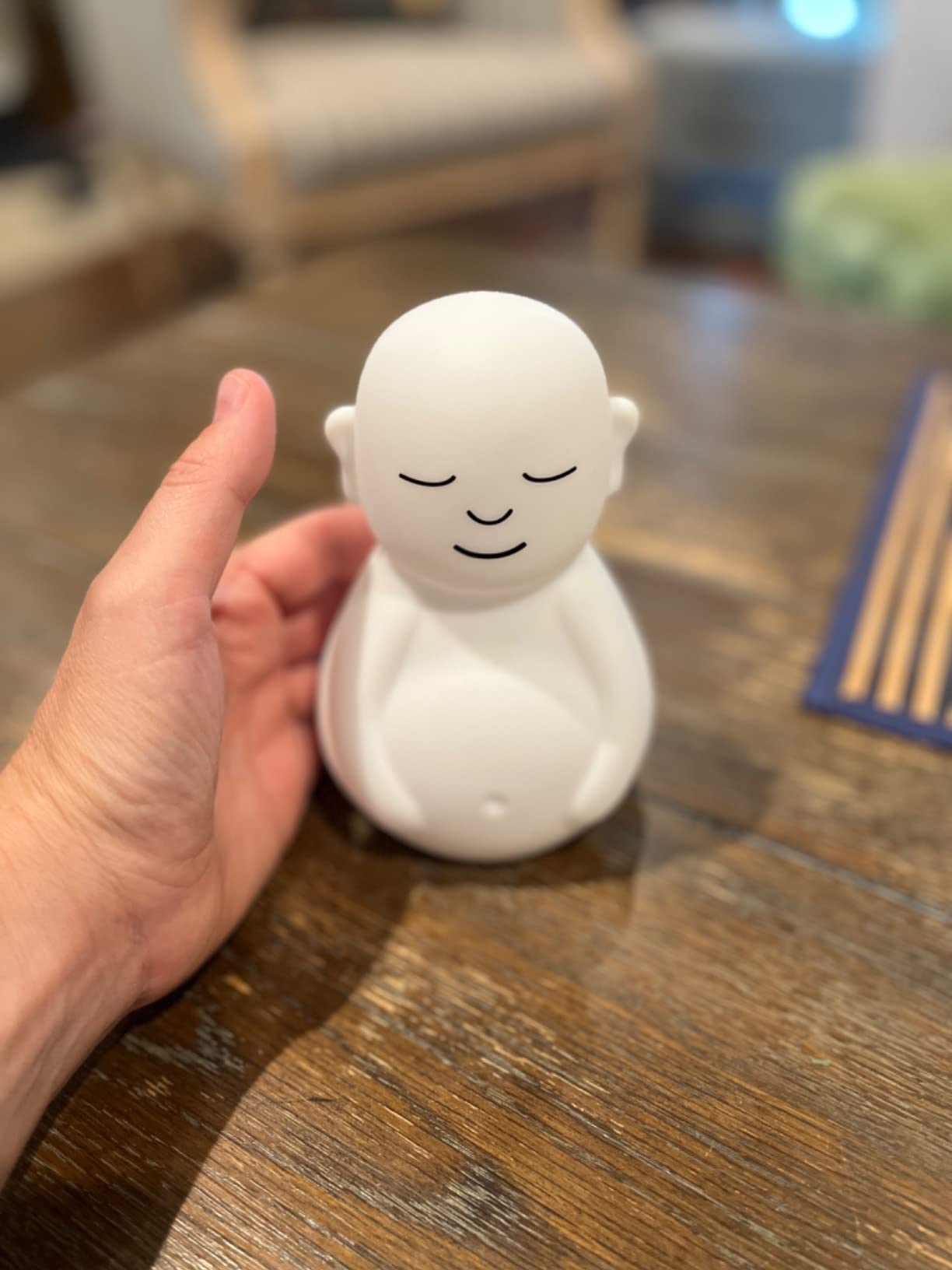
The Breathing Buddha by Mindsight is a guided breathing light designed to help you slow your breath, reduce stress, improve focus, and support relaxation.
Instead of using an app or another screen, the Breathing Buddha gives you a visual rhythm to follow. Its light guides your breathing so you can inhale, hold, and exhale with less effort.
This can be helpful when your mind feels tired, scattered, or overstimulated.
You can use the Breathing Buddha:
- Before starting focused work
- After a long screen-heavy day
- During a midday reset
- Before bed
- Between meetings
- When your thoughts feel too loud
- When you need a screen-free calming cue
The Breathing Buddha includes an expanding and fading LED breath light, USB-C rechargeability, optional sound mode, and multiple guided breathing modes. It can support stress reduction, bedtime calm, mindfulness training, and focus support.
Breathing Buddha
A screen-free guided breathing light that helps create a calm rhythm for focus, stress relief, mindfulness practice, and relaxation.
Explore the Breathing BuddhaFinal Thoughts
Mental tiredness is real.
Even if your body still has energy, your mind can feel drained from too much input, too many decisions, too much switching, and not enough quiet.
You do not always need to push harder.
Sometimes the most helpful thing you can do is pause, breathe, simplify, and give your brain fewer things to carry.
Start with one small reset today.
Close a tab. Put your phone away. Take one slow breath. Give your attention one place to land.
Your mind does not need to be forced back into focus.
It needs space to come home.